

Employee demographics and the nature of the Asian economy are presently such that companies are increasingly finding it a challenge to mobilise staff, particularly from key Asian growth locations such as China, Indonesia, Malaysia, Singapore and Thailand.
Attraction and retention
Part of the problem is employee reluctance to take the risk associated with an assignment. High unemployment rates in Europe mean that it is relatively easy for companies to attract staff to take an international assignment. Contrast this with Asian locations such as Singapore, with an unemployment rate which is lower than 2%. Combined with the knowledge that remaining in Singapore and changing employer on a periodic basis (approximately once every 2 years) will often lead to a reasonable salary bump (circa 10%) with each move, employees are often reluctant to commit to taking an international assignment of 3 years. There is a justifiable fear that while based outside of Singapore the employee may be passed over in terms of promotion or development opportunities.
Dual career couples
Family issues can also act as a barrier to mobility. Many countries in Asia have a high number of females in employment, resulting in a very real challenge where one of a couple will likely experience disruption to their career if they choose to accompany the other on an international move. This is reflected to some degree in the mobility policies of Asian multinational companies, which are more likely to include provision for financial compensation for this, although by no means is this universal.
Children’s education
While education is a concern for any expatriate with dependent children, competition for good school places in Asia is high, presenting a bigger barrier to mobility than education usually does; even if suitable education is provided for the assignment duration, re-enrolment to the desired school on repatriation may not be possible. Furthermore, as yet, it can be difficult to find international schools teaching Asian curricula to provide on-assignment education.
Impact of one-child policy
For Chinese companies, the matter is compounded by the impact of China’s long-standing, although recently relaxed, one-child policy together with its rapidly ageing population. Individuals who are likely to be expatriated by a company may now be responsible for the well-being of both their children and their parents, responsibilities which are likely to make staff more reluctant to move overseas. Together with China’s ‘Hukou’ resident system, which influences access to education, housing and social security benefits, if the international assignment is likely to adversely impact the employee’s residence status, particularly in key cities such as Beijing and Shanghai, the employee’s reluctance to move is likely to be further heightened.
Unaccompanied assignments and allowances
Such family issues mean that companies in Asia are more likely than their global peers to allow unaccompanied assignments and provide allowances designed to facilitate employee mobility than their counterparts from other countries.
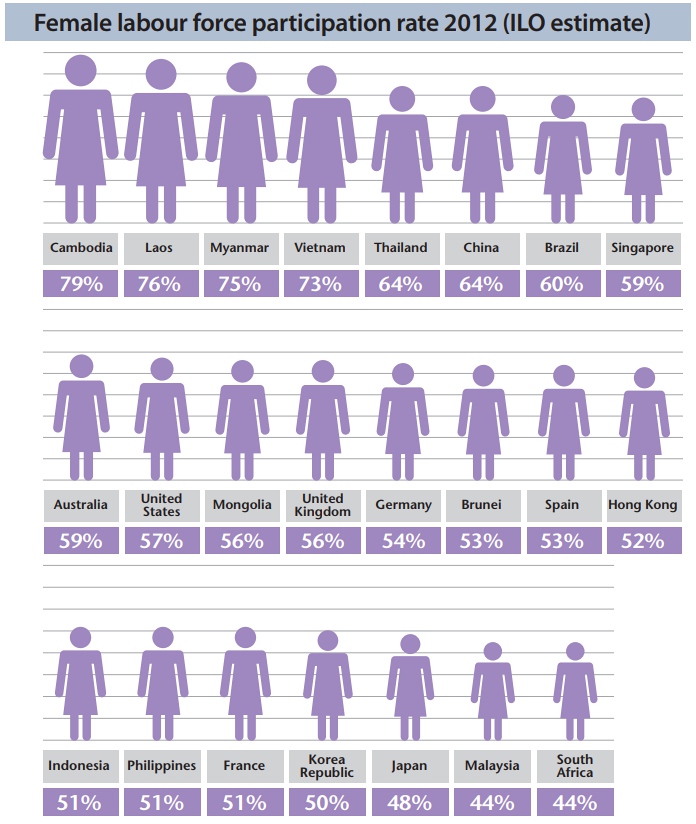
Source: ECA report ‘Regional Perspectives – Mobility in Asia’